레이블이 spinal surgery인 게시물을 표시합니다. 모든 게시물 표시

2015년 1월 22일 목요일

[논문리뷰]척추수술 시행 후 수술부위의 감염을 진단하는데 있어서의 18FDG PET/CT의 역할 : Role of 18 F-Fluoro- D -deoxyglucose PET/CT in Diagnosing Surgical Site Infection After Spine Surgery With Instrumentation

[논문리뷰]척추수술 시행 후 수술부위의 감염을 진단하는데 있어서의 18FDG PET/CT의 역할


2015년 1월에 Spine에 출판된 논문 입니다. 바로 얼마전에 나왔네요.

제목을 보자마자 반가웠습니다.
PET(양전자 방출 단층 촬영기)-CT는 암 진단 시 주로 사용하기 때문에 척추분야에서 사용하지 않는 줄 알았는데요, 척추수술 후 infection진단 용으로도 사용한다고 하네요.

암세포 진단 시, 방사선 동위원소인 18FDG(Fluoro Deoxy Glucose)를 환자에게 주입하여 암세포가 있는 부위에서 glucose(포도당)이 많이 소모되는 원리를 이용하여 infection을 진단하는 것 일까요?


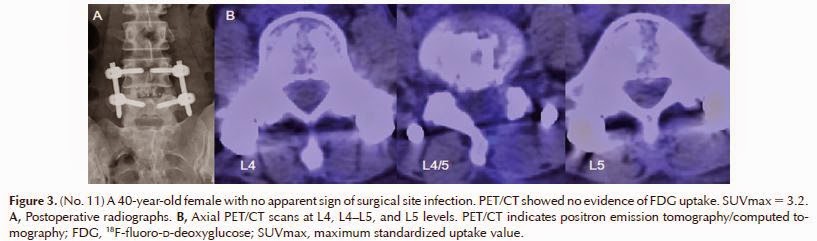
본 연구에서는 2008년부터 2012년까지 후방경유 요추체 유합술(Posterior Lumbar Interbody Fusion)을 시행한 환자 811명을 대상으로 혈액검사 결과와 임상적 증상, PET-CT촬영 결과를 가지고 술 후 감염여부를 조사하였습니다.

조사결과, PET-CT촬영 결과 infection이 있다고 진단된 8명의 환자들은 실제로도 infection이 있는 것으로 밝혀졌습니다.

PET-CT는 척추수술 후의 감염을 진단하는데에 있어 효과적이라는 결론 입니다.


척추분야와 관련된 PET-CT논문이 있는지 찾아본 결과, 15개 정도가 검색되었습니다.
막상 쓸만한 논문은 별로 없네요..

아래는 그 중 2개의 초록 입니다.


2014년 2월 12일 수요일

Risk of infection following posterior instrumented lumbar fusion for degenerative spine disease in 817 consecutive cases

Brief review

이 논문은 퇴행성 척추질환으로 후방경유 요추 유합술을 시행한 817명의 환자 데이터를 리뷰하여 감염에 영향을 끼칠 수 있는 요소를 밝힌 논문 입니다.
감염과 연관된 요소를 밝히기 위해 ‘단계적 다변량 비례 위험도 회기 분석법’을 이용하였습니다.
결과적으로, 연령의 증가와 당뇨병, 비만, 이전의 척추수술 경험 및 재원일수의 증가 등이 후방 경유 요추 유합술 후의 감염의 위험성을 증가시킬 수 있는 요인으로 드러났습니다.


*Title: Risk of infection following posterior instrumented lumbar fusion for degenerative spine disease in 817 consecutive cases
퇴행성 척추질환으로 후방 경유 요추 유합술을 시행한 817명 환자들의 감염 위험성

*Authors: Kaisorn L. Chaichana, M.D., Mohamad Bydon, M.D., David R. Santiago-Dieppa, M.D., Lee Hwang, M.D., Gregory McLoughlin, M.D., Daniel M. Sciubba, M.D., Jean-Paul Wolinsky, M.D., Ali Bydon, M.D., Ziya L. Gokaslan, M.D., and Timothy Witham, M.D.Department of Neurosurgery, Johns Hopkins University School of Medicine, Baltimore, Maryland


Summary of Background
Posterior lumbar spinal fusion for degenerative spine disease is a common procedure, and its use is increasing annually. The rate of infection, as well as the factors associated with an increased risk of infection, remains unclear for this patient population. A better understanding of these features may help guide treatment strategies aimed at minimizing infection for this relatively common procedure.


Object
To ascertain the incidence of postoperative spinal infections and identify factors associated with postoperative spinal infections.


Methods
▶Subject: patients underwent instrumented posterior lumbar fusion for degenerative spine disease (1993~2010)

“Stepwise multivariate proportional hazards regression analysis” was used to identify factors associated with infection.
Variables with p < 0.05 were considered statistically significant.


Results
▶Total subjects: 817 patients underwent lumbar fusion
▶Infection patients: 37(4.5%)
-21 (57%) required operative intervention but only 3 (8%) required instrumentation removal as part of their infection management.

▶The factors independently associated with an increased risk of infection.
1) increasing age (RR 1.004 [95% CI 1.001–1.009], p = 0.049)
2) diabetes (RR 5.583 [95% CI 1.322–19.737], p = 0.02)
3) obesity (RR 6.216 [95% CI 1.832–9.338], p = 0.005)
4) previous spine surgery (RR 2.994 [95% CI 1.263–9.346], p = 0.009)
5) increasing duration of hospital stay (RR 1.155 [95% CI 1.076–1.230], p = 0.003)

Conclusions
-older age, diabetes, obesity, prior spine surgery, and length of hospital stay: independently associated with an increased risk of infection in lumbar fusion for degenerative spine disease


-The overwhelming majority of these patients were treated effectively without hardware removal.

2013년 11월 14일 목요일

Risk of infection following posterior instrumented lumbar fusion for degenerative spine disease in 817 consecutive cases.

Brief review


이 논문은 퇴행성 척추질환 때문에 후방경유 요추 유합술을 받은 817명의 환자에게 나타난 감염률과 감염에 영향을 끼치는 요소들을 연구한 논문 입니다.
후향적으로 환자의 데이터를 검토하여 감염률을 조사했고, 단계적 다변량 비례 위험 회귀분석법을 통하여 요추감염과 연관성이 있는 요소들을 알아냈습니다.
연구대상인 817명의 환자에 대해서는 감염률이 4.5%로 나타났고,  나이, 당뇨지수, 비만도, 이전에 척추수술을 시행했는지의 여부, 재원기간 등의 요소들이 감염에 영향을 끼치는 것으로 나타났습니다.


*Title: Risk of infection following posterior instrumented lumbar fusion for degenerative spine disease in 817 consecutive cases.
퇴행성 척추질환으로 후방경유 요추 유합술을 시행한 817명의 사례에 대한 감염의 위험성

*Author: Kaisorn L. Chaichana, Mohamad Bydon, David R. Santiago-Dieppa, Lee Hwang, Gregory McLoughlin, Daniel M. Sciubb a, Jean-Paul Wolinsky, Ali Bydon, Ziya L. Gokaslan, Timothy Witham


Object
The rate and factors of infection risk remains unclear for Posterior lumbar spinal fusion (for degenerative spine disease)
Purpose: To ascertain the incidence and factors of postoperative spinal infections.


Methods
▶Period: 1993 ~ 2010
▶Subject: 817 patients who underwent posterior lumbar fusion for degenerative disease.
-Retrospectively data reviewed.
-To identify the infection factors, using Stepwise multivariate proportional hazards regression analysis.


Results
1. Infection rate: 4.5%
(37 patients out of 817 patients developed postoperative spine infection at a median of 0.6 months (IQR 0.3-0.9) ).

2. Infection factors
1. age (RR 1.004 [95% CI 1.001-1.009], p = 0.049)
2. diabetes (RR 5.583 [95% CI 1.322-19.737], p = 0.02)
3. obesity (RR 6.216 [95% CI 1.832-9.338], p = 0.005)
4. previous spine surgery (RR 2.994 [95% CI 1.263-9.346], p = 0.009)
5. duration of hospital stay (RR 1.155 [95% CI 1.076-1.230], p = 0.003).


Conclusions

-Several factors were associated with an risk of infection among patients underwent lumbar fusion for degenerative disease. (factors: older age, diabetes, obesity, prior spine surgery, and length of hospital stay)